Tuesday, 19 February 2019

Britain’s largest Neolithic house ‘built in Scotland’

The remains of the largest Neolithic hall found in Britain, which was were discovered in Carnoustie, Angus. 
PIC: GUARD Archaeology.

The largest Neolithic house in Britain was built in Scotland around 6,000 years ago, archaeologists have confirmed

Two halls which were used as houses and likely home to large numbers of people have been discovered in Carnoustie, Angus.

The site is far larger and older than previously thought with archaeological work shedding new light on some of Scotland’s earliest communities.

Analysis shows food was processed and consumed in the halls with pottery made and used there.

It is possible that animals were also kept in part of the building.

Read the rest of this article...

Ancient DNA from Viking Graves Proves the Fierce Fighters Rode Male Horses

Modern Icelandic horses are likely descended from the horses that Vikings were buried with, 
more than 1,000 years ago.
Credit: Albína Hulda Pálsdóttir

Vikings who settled in Iceland more than 1,000 years ago valued their horses so much that the men were buried with their trusty steeds. And DNA analysis of these treasured animals recently proved that the horses consigned to the grave with their manly owners were males, too.
For decades, archaeologists have studied the contents of hundreds of Viking graves in Iceland. Many of these graves also contained the remains of horses that appeared to have been healthy adults when they died.
Because the horses seemed well cared for in life — before they were killed and buried, that is — they were considered to be important to the men whose remains lay nearby. Recently, scientists conducted the first ancient DNA analysis of bones from 19 horses in Viking graves, and found that nearly all of the animals were male, a tantalizing clue about vanished Viking culture
Read the rest of this article...

Decapitated bodies found in Roman cemetery in Great Whelnetham

The team found a number of decapitated Roman burials
ARCHAEOLOGICAL SOLUTIONS

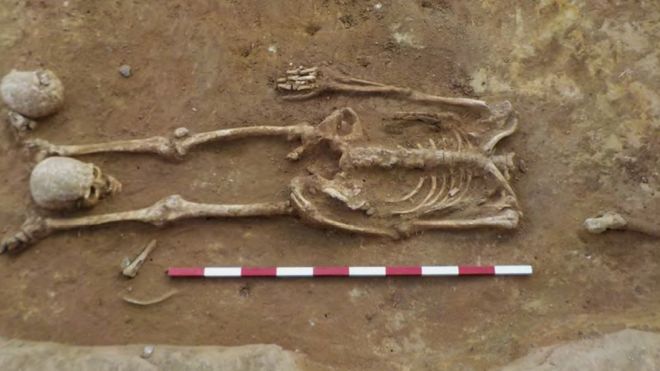
Archaeologists excavating a Roman burial ground said the discovery of a series of decapitated bodies was a "rare find".

A dig has been taking place on a site in Great Whelnetham, Suffolk, ahead of a planned housing development.

Of the 52 skeletons found, about 40% had their skulls detached from their bodies, many placed by their legs.

Archaeologist Andrew Peachey said it gave a "fascinating insight" into Roman burial practice.

Read the rest of this article...
Ancient burial site and monument found in England's New Forest

he urns contained cremated human bone and had been placed into small pits 
[Credit: New Forest National Park Authority via BBC]

Archaeologists and volunteers have found an important prehistoric burial site near Beaulieu dating back thousands of years.
A community dig in a field at East End set out to investigate what they thought was a Bronze Age barrow which had been ploughed over and they were thrilled to find four cremation burial urns dating from that period around 3,000 years ago.

But as the excavation progressed further, the evidence began suggesting that the site might have been an important place for even older human activity which Bronze Age settlers then adapted.

New Forest National Park Authority Community Archaeologist James Brown said: ‘We were elated to find the urns – they were inverted in what we originally thought was the ditch around the barrow and one has a decorative band pattern on it that will help us to date them. These urns were domestic pots and contain cremated human bone placed into small pits. So we know this site was a place of memorial for people in the New Forest around 3,000 years ago.

Read the rest of this article...
'Witches' marks' found in British cave network


The "witches' marks" are scribed into walls and ceilings of the caves, 
over dark holes and large crevices 
[Credit: © Creswell Heritage Trust]

They were discovered at Creswell Crags, Nottinghamshire, and are believed to be the biggest concentration of protective marks found in British caves.

The "apotropaic" marks were scribed into the cave surface as they were thought to keep evil spirits coming from the underworld.

Originally thought to be graffiti, they have now been reclassified.

Read the rest of this article...

Monday, 18 February 2019

Pembrokeshire chariot burial finds ruled as treasure

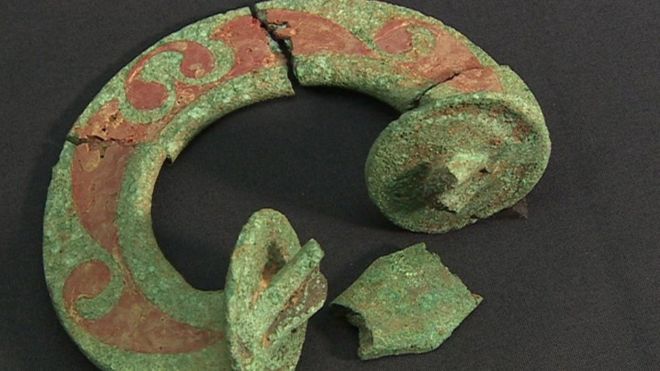
his terret ring would have guided the chariot reins
Parts of an Iron Age chariot found by a metal detectorist have been declared treasure by the Pembrokeshire coroner.
Mike Smith made the discovery in February 2018 on farmland in the south of the county.
The court at Milford Haven heard on Thursday the finds were part of the ritual burial of an entire chariot and that the site is now legally protected.
Mr Smith says the 2,000-year-old finds could be worth a "life-changing" six to seven figure sum.
The nine artefacts are now Crown property and a independent valuation committee will decide on the payment to Mr Smith.

Read the rest of this article...

Sheela-na-gigs: The naked women adorning Britain's churches

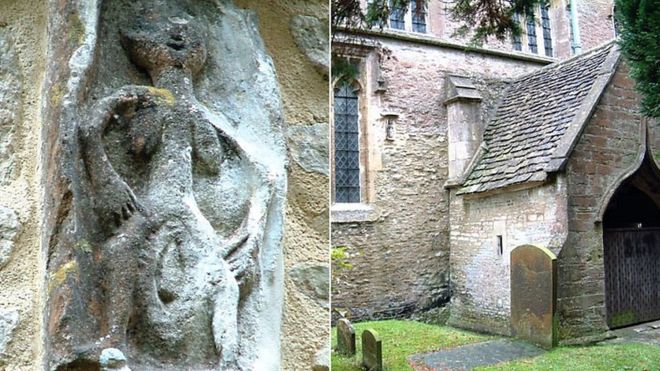
This sheela-na-gig at Oaksey in Wiltshire boasts "pendulous breasts" and a vulva
"extended almost to her ankles"
For hundreds of years carvings of naked women have sat provocatively on churches across Britain. But who created them - and why?
Look at these, my child-bearing hips
Look at these, my ruby red ruby lips...
Sheela-na-gig, Sheela-na-gig
You exhibitionist
The year is 1992 and the singer-songwriter PJ Harvey is performing Sheela-Na-Gig, the most successful single from her critically acclaimed album Dry.
But unless you're a fan of late 20th Century indie music, or an expert in Norman church architecture, there's every chance you've not been exposed to the sheela-na-gig - or have sauntered past one without even realising it.
Hidden in plain sight, these sculptures of squatting women pulling back the lips of their vaginas have for nearly a millennium aroused feelings of intrigue, shame and even anger.

Read the rest of this article...

Ancient marble head of god Dionysus discovered under Rome

The head of Dionysus was found near the Roman Forum. Photos:  Archeological Park of the Colosseum. Archeologists in Rome have uncovered a la...