Thursday, 14 March 2019

Hominids may have hunted rabbits as far back as 400,000 years ago

BUNNY TRAIL  Fossils from southern European sites indicate that ancient relatives of humans hunted small, fast animals as early as around 400,000 years ago. Ends of rabbit bones (shown) were probably snapped off to remove marrow.

In Europe, Stone Age hominids began adding small, fast animals to their menus much earlier than previously thought, scientists say.

Now-extinct members of the human genus, Homohunted rabbits and, to a lesser extent, hares in southern France and probably other Mediterranean parts of Europe by around 400,000 years ago, researchers report online March 6 in Science Advances. Hunters also bagged larger creatures such as wild goats and deer. The new finding may highlight the flexibility and innovativeness of these ancient relatives of humans.

That dietary shift to smaller animals away from eating primarily large game emerged long before a previously recognized change in ancient humans’ eating habits, concludes a team led by paleoanthropologist Eugène Morin of Trent University in Peterborough, Canada. In the later transition, Stone Age people dramatically broadened what they ate, including a wide variety of small animals, starting around 36,000 years ago.

Read the rest of this article...

Researchers find a piece of Palaeolithic art featuring birds and humans

A tracing of the engraved figures over the stone [Credit: University of Barcelona]

It is not very common to find representations of scenes instead of individual figures in Palaeolithic art, but it is even harder for these figures to be birds instead of mammals such as goats, deer or horses. So far, historians have only found three scenes of Palaeolithic art featuring humans and birds in Europe.

Now, an article published in the journal L'Anthropologie tells how University of Barcelona researchers found -in the site of Hort de la Bequera (Margalef de Montsant, Priorat)-, an artistic piece from 12,500 years ago in which humans and birds try to interact in a pictorial scene with exceptional traits: figures seem to star a narration on hunting and motherhood.

Regarding the Catalan context in particular, this is an important finding regarding the few pieces of Palaeolithic art in Catalonia and it places this territory within the stream of artistic production of the upper Palaeolithic in the Mediterranean.

Read the rest of this article...

Stonehenge was 'hub for Britain's earliest mass parties'

Pigs were the main food at the feasts and were brought from as far away as Scotland and the North East of England to Stonehenge
ENGLISH HERITAGE/PA

Evidence of large-scale prehistoric feasting rituals found at Stonehenge could be the earliest mass celebrations in Britain, say archaeologists.

The study examined 131 pigs' bones at four Late Neolithic sites, Durrington Walls, Marden, Mount Pleasant and West Kennet Palisade Enclosures.

The sites, which served Stonehenge and Avebury, hosted the feasts.

Researchers think guests had to bring meat raised locally to them, resulting in pigs arriving from distant places.

Read the rest of this article...

HABITATS DE L’ÂGE DU BRONZE, SILOS ET RITUELS GAULOIS À FAUX-FRESNAY


À Faux-Fresnay, dans la Marne, une équipe d’archéologues de l’Inrap a découvert des vestiges de deux villages de l’âge du Bronze et de l’âge du Fer qui témoignent d’une importante activité agricole. Des silos où reposent des restes d’animaux interrogent sur des rituels qui auraient impliqué le cheptel. Cette fouille est réalisée en amont de l’aménagement d’un poste électrique par RTE.

Read the rest of this article...

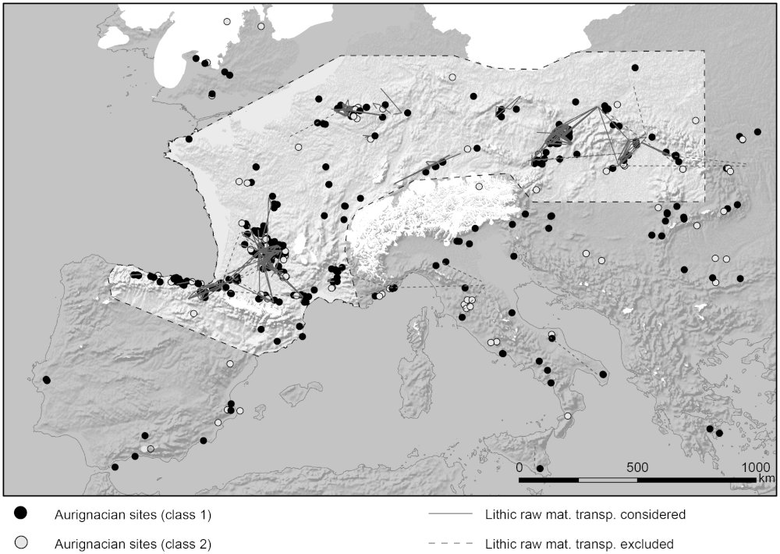
In Europa lebten im frühen Jungpaläolithikum im Schnitt nur 1.500 Menschen


Mit einem an der Universität zu Köln entwickelten Protokoll können die Forscherinnen und Forscher des Sonderforschungsbereiches 806 "Our Way to Europe" rekonstruieren, wie die Besiedlung Europas durch den anatomisch modernen Menschen verlief. Die Daten zeigen, dass die Population der gesamten europäischen Jäger und Sammler in der Zeitspanne von etwa 42.000 bis etwa 33.000 Jahren vor heute – dem sogenannten Aurignacien – durchschnittlich nur etwa 1.500 Personen betrug.

Read the rest of this article...

Tuesday, 12 March 2019

Home of 7th Century princess unearthed in Coldingham

The dig concentrated on ground around Coldingham Priory in the Borders
DIGVENTURES/AERIAL-CAM

Archaeologists believe they have found remains of the long-lost home of a 7th Century princess in the Borders.

A monastery was founded near the village of Coldingham by Princess Æbbe nearly 1,400 years ago.

It was destroyed by Viking raiders in the 9th Century and previous attempts to pinpoint its location have failed.

However, excavations led by DigVentures have found traces of a large, narrow ditch which they believe was the boundary of the religious settlement.

Read the rest of this article...

'Hobbit' human story gets a twist, thanks to thousands of rat bones


The limestone cave of Liang Bua, on the Indonesian island of Flores, is widely known as the hobbit cave, the site where the surprisingly tiny and enormously controversial extinct human relative Homo floresiensis was discovered. But to the scientists who excavate there, the site is known as something else entirely: the rat cave.
“The first time I went to the excavations at Liang Bua, I remember watching the bones coming out of the ground and being amazed at how it was almost all rat,” recalls Matthew Tocheri, the Canada Research Chair in Human Origins at Lakehead University.
Read the rest of this article...

Ancient marble head of god Dionysus discovered under Rome

The head of Dionysus was found near the Roman Forum. Photos:  Archeological Park of the Colosseum. Archeologists in Rome have uncovered a la...