Monday, 18 March 2019

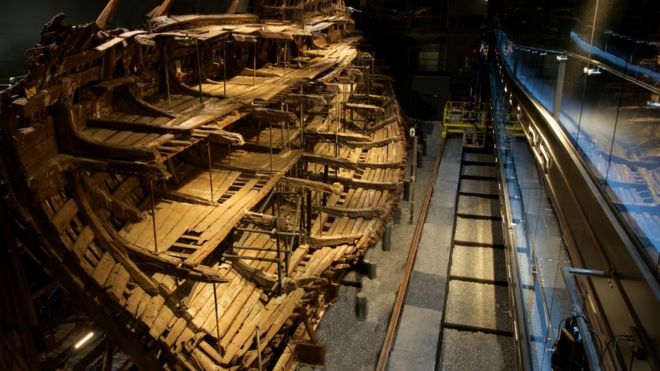
Mary Rose crew 'was from Mediterranean and North Africa'

The Mary Rose Museum in Portsmouth's Historic Dockyard houses a cross section of the ship's hull as well as thousands of artefacts, including weapons and jewellery
STEPHEN FOOTE

The crew on board the sunken Henry VIII ship the Mary Rose was from the Mediterranean, North Africa and beyond, researchers have found.

Bone structure and DNA of 10 skeletons found on board were analysed by team at Cardiff and Portsmouth universities.

They said four of the skeletons were of southern European heritage, and one seems to have hailed from Morocco or Algeria.

The findings cast fresh light on the ethnic makeup of Tudor Britain.
The Mary Rose sank in 1545 in the Solent during a naval battle with the French, with the loss of between 400 and 600 lives.

Read the rest of this article...

Archaeologists discovered a flintstone workshop of Neanderthals in the southern Poland; it is approx. 60,000 years old


Researchers discovered a flint workshop of Neanderthals in Pietraszyno (Silesia). According to scientists, it is the first such large workshop in Central Europe that was not located in a cave. So far, researchers have counted 17,000 stone products created 60 thousand years ago.

Neandertals (Homo neanderthalensis) were very close relatives of contemporary man (Homo sapiens). They probably appeared in Poland approximately 300,000 years ago. The oldest stone tools they used, discovered on the Vistula, are over 200,000 years old, and the remains are over 100,000 years old.

"On the bank of the river in Pietraszyno, we discovered an unprecedented amount of flint products - 17,000 - abandoned by Neanderthals approximately 60,000 years ago" - says Dr. Andrzej Wiśniewski from the Institute of Archaeology, University of Wrocław. Since 2018, the researcher has been conducting joint excavations with researchers from the Max Planck Institute for Evolutionary Anthropology in Leipzig in the framework of a National Science Centre project. In his opinion, this is the first such large Neandertal workshop discovered in Central Europe that was not located in a cave.

Read the rest of this article...
Ancient switch to soft food gave us an overbite—and the ability to pronounce ‘f’s and ‘v’s

An ancient woman from Romania shows an edgeto-edge bite (left). A Bronze Age man from Austria had a slight overbite (right). D. E. BLASI ET AL., SCIENCE, 363, 1192 (2019)

Don't like the F-word? Blame farmers and soft food. When humans switched to processed foods after the spread of agriculture, they put less wear and tear on their teeth. That changed the growth of their jaws, giving adults the overbites normal in children. Within a few thousand years, those slight overbites made it easy for people in farming cultures to fire off sounds like "f" and "v," opening a world of new words.

The newly favored consonants, known as labiodentals, helped spur the diversification of languages in Europe and Asia at least 4000 years ago; they led to such changes as the replacement of the Proto-Indo-European patēr to Old English faeder about 1500 years ago, according to linguist and senior author Balthasar Bickel at the University of Zurich in Switzerland. The paper shows "that a cultural shift can change our biology in such a way that it affects our language," says evolutionary morphologist Noreen Von Cramon-Taubadel of the University at Buffalo, part of the State University of New York system, who was not part of the study.

Read the rest of this article...
Artificial intelligence for the study of sites


Three examples of the different types of notches 
[Credit: A. Moclán]

An experimental study led by researcher Abel Moclán, from the Centro Nacional de Investigación sobre la Evolución Humana (CENIEH), has just been published in the Archaeological and Anthropological Sciences journal, which proposes a new method to understand how the faunal assemblages were generated in archaeological sites, and how they could have interacted with groups of humans and carnivores in the places they occupied.

This new method involves the use of artificial intelligence and machine learning algorithms to decipher whether faunal assemblages were generated by hominids or carnivores, specifically hyenas and/or wolves. "Thanks to this method, we can discern among the acting agents with a certainty of over 95%," says Abel Moclán.

To carry out this study, bone fractures have been analyzed in order to interpret whether they were fractured by human groups to consume the bone marrow, or if, on the contrary, the carnivores fractured the bones when trying to access this same resource.

Read the rest of this article...

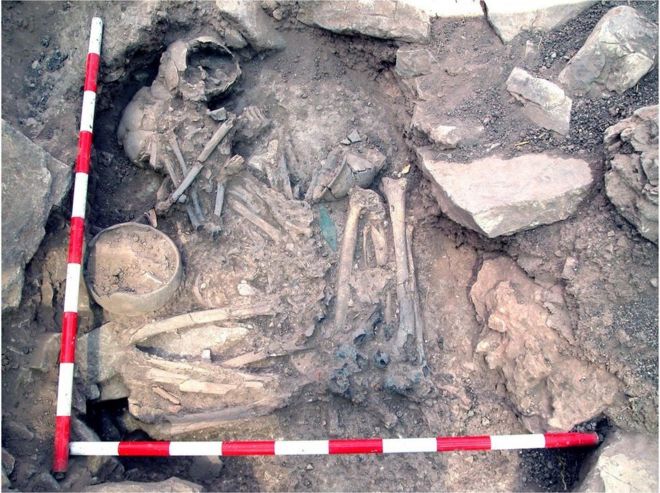
Ancient migration transformed Spain's DNA

Bronze Age burials: Iberia saw a dramatic genetic shift during this period
L BENITEZ DE LUGO ENRICH - JOSE LUIS FUENTES SANCH

A migration from Central Europe transformed the genetic make-up of people in Spain during the Bronze Age, a study reveals.

DNA evidence shows the migrants streamed over the Pyrenees, replacing existing male lineages across the region within a space of 400 years.

It remains unclear whether violence played a role or whether a male-centric social structure was more important.

The result comes from the most extensive study of its kind.

Researchers reconstructed the population history of Iberia (modern Spain, Portugal, Gibraltar and Andorra) over 8,000 years - the biggest slice of time tackled by a single ancient DNA study. The region has been a crossroads for different cultures over time.

Read the rest of this article...

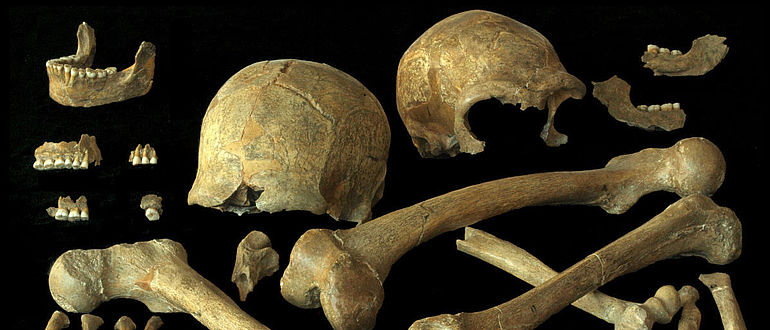
Neandertaler und moderne Menschen hatten ähnliche Speisezettel

Knochen aus Spy geben Aufschluss über Ernährung und Mobilität der dortigen Neandertaler. Foto: Royal Belgian Institute of Natural Sciences (RBINS)

Internationale Studie findet mehr gemeinsame Nahrungsvorlieben als angenommen ‒ Rätselhafte Spuren von Kannibalismus

Neandertaler und der frühe moderne Mensch ernährten sich vermutlich sehr ähnlich: Zu diesem Schluss kommt eine internationale Studie und widerspricht damit der Annahme, die Neandertaler seien ausgestorben, weil ihr Ernährungsspektrum eingeschränkt war. Die Ergebnisse zeigten aber auch, dass moderne Menschen dennoch einen Vorteil hatten, weil sie vermutlich mobiler und besser vernetzt waren, berichtet das Team um Dr. Christoph Wißing von der Universität Tübingen.

Read the rest of this article...

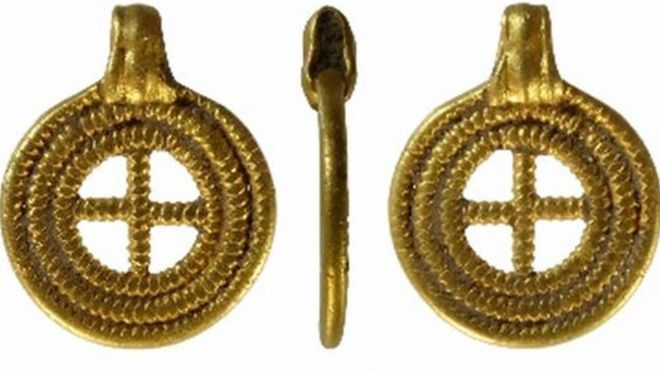
Anglo-Saxon gold pendant found in Norfolk declared treasure

The gold pendant would have belonged to a "high status woman", like the famous Winfarthing Pendant
COURTESY OF THE PORTABLE ANTIQUITIES SCHEME

An Anglo-Saxon gold pendant, found near a site where a similar item worth £145,000 was dug up, probably belonged to a woman of "high social status".

The Winfarthing Pendant was found in 2014 near Diss in Norfolk.

The latest pendant, with a central cross motif, was found in 2017 and it has been declared treasure.

Julie Shoemark, Norfolk's finds liaison officer, said it made a "valuable contribution to our understanding of Saxon society".

Read the rest of this article...

Ancient marble head of god Dionysus discovered under Rome

The head of Dionysus was found near the Roman Forum. Photos:  Archeological Park of the Colosseum. Archeologists in Rome have uncovered a la...