Thursday, 4 April 2019

Climate change drove some Neanderthals to cannibalism

File photo - Hyperrealistic face of a neanderthal male is displayed in a cave in the new Neanderthal Museum in the northern Croatian town of Krapina Feb. 25, 2010. (REUTERS/Nikola Solic)

Six Neanderthals who lived in what is now France were eaten by their fellow Neanderthals some 100,000 years ago, according to gruesome evidence of the cannibalistic event discovered by scientists in a cave in the 1990s.

Now, researchers may have figured out why the Neanderthals, including two children, became victims of cannibalism: global warming.

While prior studies have interpreted Neanderthal remains to find proof of cannibalistic behavior, this is the first study to offer clues as to what may have led Neanderthals to become cannibals. Scientists found that rapid shifts in local ecosystems as the planet warmed may have extinguished the animal species that Neanderthals ate, forcing them to look elsewhere to fill their bellies. 

Read the rest of this article...

Wednesday, 3 April 2019

Neolithic Britons travelled across country for regular mass national feasts 4,500 years ago, new research claims

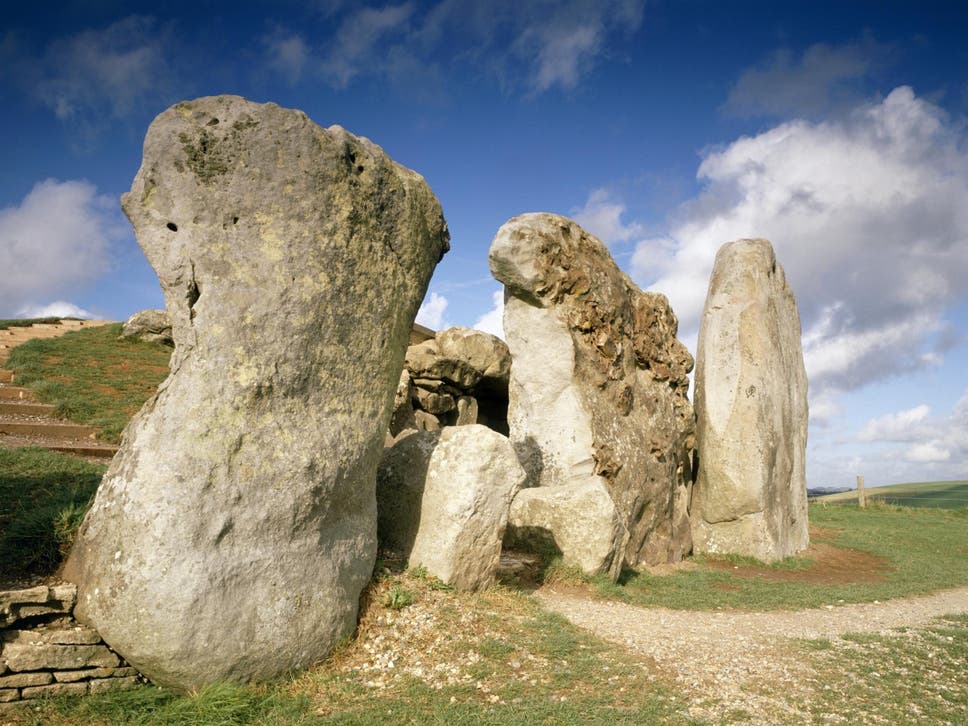
Feasts were held at ritual sites, including Avebury ( English Heritage )

Findings suggest prehistoric tribes may have established cultural and political bonds – and an early national identity – long before previously believed

New scientific discoveries are set to dramatically transform our understanding of prehistoric Britain.

A study of Stonehenge-era archaeological material from large-scale ceremonial feasts is revealing that neolithic Britain was, in key respects, much more interconnected and unified than previously thought.

The evidence reveals that people from virtually every part of the country came together to participate in major, almost certainly politico-religious, ceremonies.

Some participants travelled hundreds of miles from Scotland, northeast England, the midlands and Wales to significant ritual locations in what are now Wiltshire and Dorset.

Read the rest of this article...

Norway finds another Viking ship


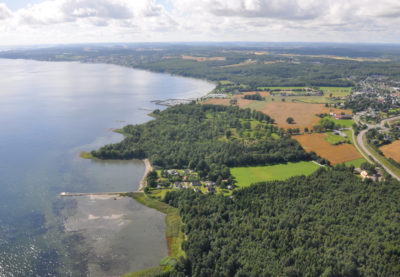
The fields and forests of Borre in Vestfold run along the west side of the Oslo Fjord, in a county that has produced Norway’s other famed Viking ships. 
PHOTO: Vestfold fylkeskommune


On an open field along the Oslo Fjord, among grave mounds from the Viking Age, archaeologists have found what they believe is another buried Viking ship. The discovery was made with the help of georadar that shows a ship-shaped object.

The ship’s form was actually first spotted nearly two years ago, but many examinations were needed in order to confirm that it’s another Viking ship. Ola Elvestuen, Norway’s government minister in charge of climate and the environment, announced the discovery on Monday along with the local Vestfold County Governor Rune Hogsnes.

“It’s not every day we find a new Viking ship, so this is really exciting,” Hogsnes told reporters at a press conference Monday morning. “For us locals it’s no surprise. A lot of treasures from the Viking times are hidden under the turf in our county.”

Read the rest of this article...

Pompeii ‘fast food’ bar unearthed in ancient city after 2,000 years

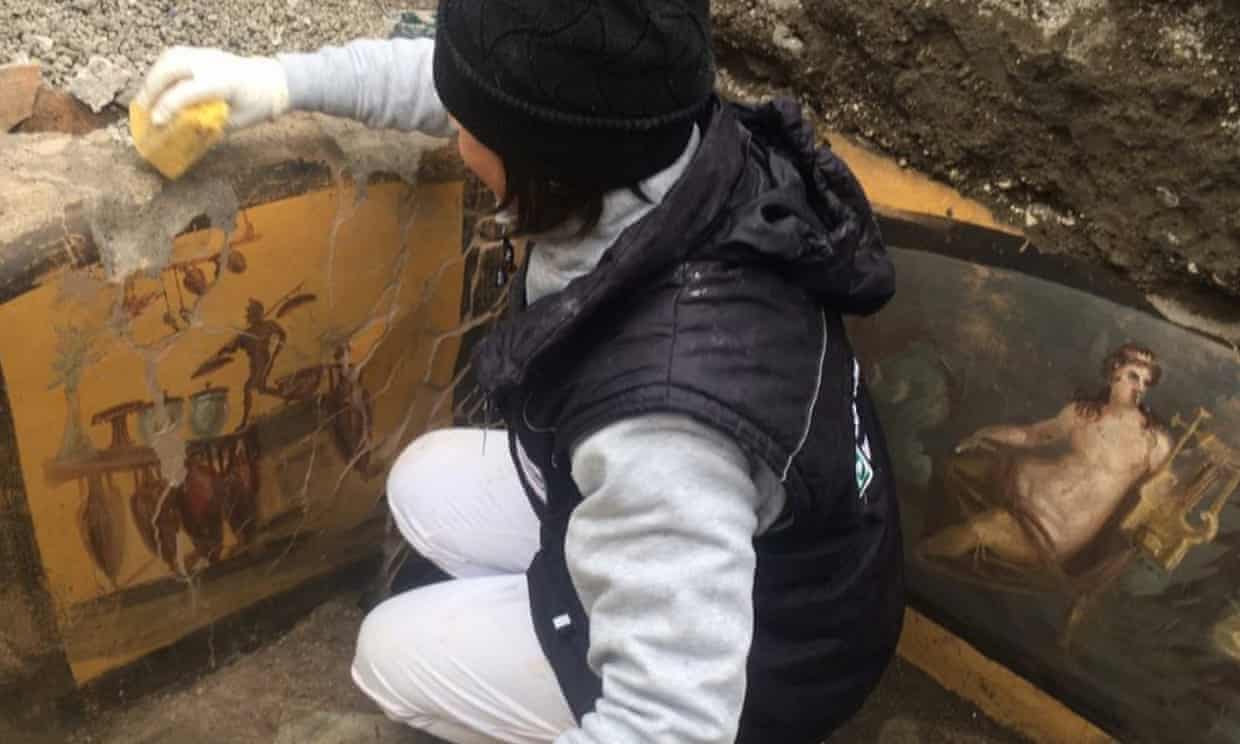
Dozens of thermopolia, or snack bars, have been found across Pompeii.
Photograph: Massimo Ossana/Instagram

Thermopolia used by poorer residents with few cooking facilities, archaeologists say

A well-preserved frescoed “fast food” counter is among the latest discoveries unearthed by archaeologists in the ancient Roman city of Pompeii.

The 150 or so thermopolia, or snack bars, dotted across the city were mostly used by the poorer residents, who rarely had cooking facilities in their home, to grab a snack or drink. Typical menus included coarse bread with salty fish, baked cheese, lentils and spicy wine.

An image of the 2,000-year old relic, found in Regio V, a 21.8-hectare (54-acre) site to the north of the archaeological park, was shared on Instagram by Massimo Ossana, the site’s outgoing superintendent.

“A thermopolium has been brought back to light, with its beautiful frescoed counter,” he wrote.

Read the rest of this article...

LES ARCHÉOLOGUES DE L’INRAP DÉCOUVRENT UNE TOMBE ÉTRUSQUE EN HYPOGÉE À ALERIA–LAMAJONE


Une équipe d’archéologues de l’Inrap fouille actuellement une exceptionnelle sépulture étrusque à Aleria-Lamajone (Haute-Corse). Menée sur prescription de l’État (DRAC Corse), cette fouille a mis en évidence deux tronçons de voies et une nécropole étrusque et romaine. La découverte, parmi les sépultures, d’une tombe étrusque en hypogée creusée dans la roche, a entraîné la publication d’un arrêté complémentaire de prescription de fouilles.

Read the rest of this article...
Ancient teeth hint at mysterious human relative

The gorges of Guizhou Province glimmer in the sunlight in China. Fossil teeth found in this province suggest that millions of years ago, a cave here was home to a mysterious branch of the human family tree.
PHOTOGRAPH BY NOVARC IMAGES/ ALAMY

The find adds to a growing number of fossils from China that don't fit neatly in the existing human family tree.

FOUR TEETH FOUND in a cave in the Tongzi county of southern China have scientists scratching their heads.

In 1972 and 1983, researchers extracted the roughly 200,000-year-old teeth from the silty sediments of the Yanhui cave floor, initially labeling them as Homo erectus, the upright-walking hominins thought to be the first to leave Africa. Later analysis suggested they didn't quite fit with Homo erectus, but that's where the story paused for nearly two decades.

Now, a study published in the Journal of Human Evolution takes a fresh look at these ancient teeth, using modern methods to examine the curious remains. The new analysis excludes the possibility that the teeth could come from Homo erectus or the more advanced Neanderthals, but the elusive owner remains unknown.

Read the rest of this article...

Concerns mount over plans for two-mile road tunnel past Stonehenge

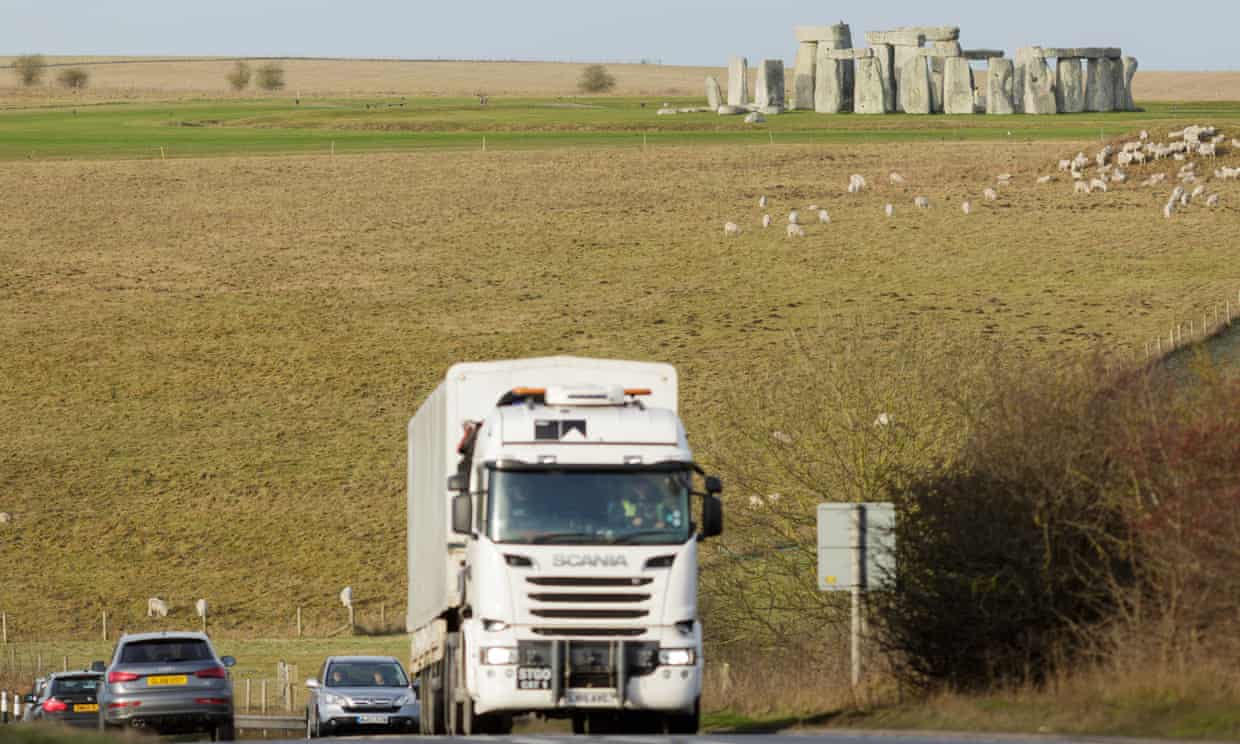
Stonehenge lies within 165 metres of the A303, a key transport link for people travelling to and from England’s south-west. Photograph: Sam Frost/The Guardian

Highways England claims scheme will improve travel and visits to site but many oppose it

Environmentalists, archaeologists, residents and druids have expressed deep concerns about a controversial scheme to build a road tunnel through the Stonehenge landscape as the £1.6bn project reaches a key milestone.

A six-month long examination of the scheme that will consider issues ranging from the impact on precious archaeological remains to how it may affect endangered birdlife and the darkness of the night sky begins on Wednesday.

At a packed preliminary meeting at Salisbury racecourse on Tuesday, there were protests about the scheme, which some have branded vandalism. More than 2,000 people, many of them opposed, have said they want to make submissions and hundreds want to give evidence in person over the next six months.

Read the rest of this article...

Ancient marble head of god Dionysus discovered under Rome

The head of Dionysus was found near the Roman Forum. Photos:  Archeological Park of the Colosseum. Archeologists in Rome have uncovered a la...