Thursday, 11 April 2019

Woolly mammoth mystery solved? Study reveals shocking details about prehistoric creature


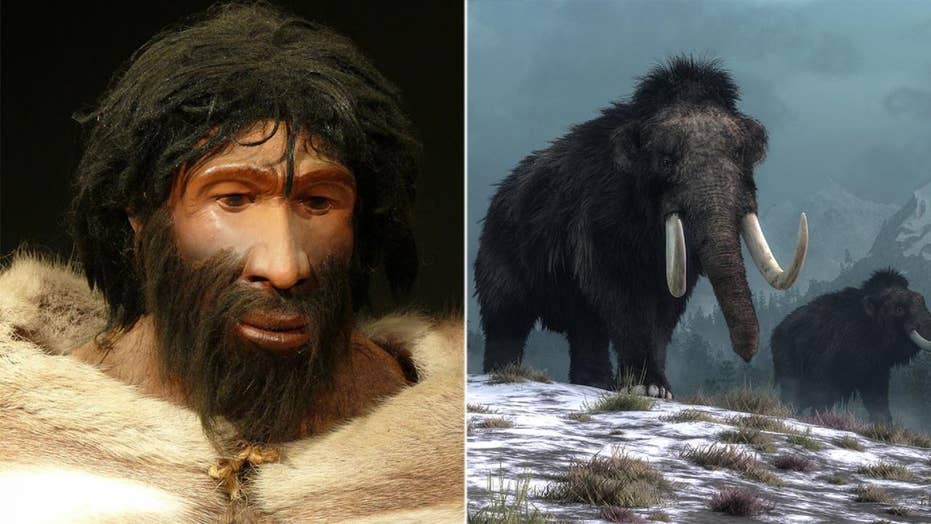
A new study suggests that woolly mammoths and mankind's ancestors, the Neanderthals, may have shared genetic traits.

Extinct for thousands of years, the woolly mammoth continues to fascinate humanity, as the prospect of eventually reviving the species is pondered among the scientific community. Now, a new study suggests that the giant creatures and mankind's ancestors, the Neanderthals, may have shared genetic traits.

The study, published by researchers at Tel Aviv University, suggests that because of their shared geography, mammoths and Neanderthals likely had similar molecular characteristics that allowed them to adapt to their harsh environmental surroundings.

"Neanderthals and mammoths lived together in Europe during the Ice Age. The evidence suggests that Neanderthals hunted and ate mammoths for tens of thousands of years and were actually physically dependent on calories extracted from mammoths for their successful adaptation," said professor Ran Barkai in a statement.

Read the rest of this article...

Stonehenge tunnel: Row over building clause in deeds

Campaigners say the deeds prevent work close to the stones

Plans for a controversial road tunnel near Stonehenge could be blocked because of conditions in the ancient monument's deeds.

The government wants to build a 1.9 mile (3km) tunnel past the Neolithic stone circle.

But when the monument was gifted to the nation by Sir Cecil Chubb in 1918 its deeds contained conditions.

Highways England said it believed the proposed tunnel did not fall within the covenant's boundary.

The issue was raised during a Planning Inspectorate preliminary meeting into the application to build the tunnel past the stones.

Read the rest of this article...

Von den Kelten bis zum Mittelalter: Eisenverhüttung im Siegerland


Vor über 2.000 Jahren war das Siegerland eine blühende Region für Eisenproduktion. In den bislang größten bekannten Verhüttungsöfen ihrer Epoche in Europa gewannen keltische Hüttenleute große Mengen an Stahl. Archäologen gelang in Siegen nun ein Nachweis dieser bisher für die Eisenzeit in Mitteleuropa einzigartigen großen Zahl an Werkstätten zur Eisenverarbeitung.

Read the rest of this article...

World-renowned Ring of Brodgar stone circle vandalised in Orkney


The Ring of Brodgar originally comprised 60 stones, of which 36 survive. 
Photograph: Murdo Macleod/The Guardian

Graffiti engraved on a stone at Neolithic monument that is part of world heritage site

A world-renowned stone circle in Orkney, which is more than 4,000 years old, has been vandalised.

Damage to the Ring of Brodgar includes graffiti that has been engraved into one of the stones at the Neolithic site near Stenness. It is believed to have been caused sometime between Friday afternoon and Sunday morning.

Insp David Hall from Police Scotland said: “The stones at the Ring of Brodgar are priceless historical artefacts and the damage caused cannot simply be estimated in monetary terms.

“For someone to damage them in this way is a particularly mindless act. I would urge anyone who has visited the area over the last weekend to think back and if they believe they may have seen something suspicious, even if it didn’t seem of much note at the time, to let us know.

Read the rest of this article...

'New species of human' found in cave throws doubt over evolution theories

Key site: Callao Cave on Luzon island in the Philippines, where fossils of Homo luzonensis were found. Photo: AFP/Getty Images

A previously unknown species of human that lived at the same time our ancient ancestors were colonising Europe has been discovered in the Philippines.
Bones and teeth of the "hominin" were found in Callao Cave on Luzon, the largest island in the Asian archipelago. They contain a mixture of old and new features that have excited scientists and threaten to overturn accepted theories of human evolution.
Hominins are members of the human family tree more closely related to one another than to apes.
Today, only one species of this group remains, Homo sapiens, to which everyone on Earth belongs.
Read the rest of this article...

New species of ancient human discovered in Philippines cave

Callao cave, where the fossils of Homo luzonensis were discovered. 
Photograph: Quincy/Alamy

Homo luzonensis fossils found in Luzon island cave, dating back up to 67,000 years
A new species of ancient human, thought to have been under 4ft tall and adapted to climbing trees, has been discovered in the Philippines, providing a twist in the story of human evolution.

The specimen, named Homo luzonensis, was excavated from Callao cave on Luzon island in the northern Philippines and has been dated to 50,000-67,000 years ago – when our own ancestors and the Neanderthals were spreading across Europe and into Asia.

Florent Détroit, of the Natural History Museum in Paris and the paper’s first author, said the discovery provided the latest challenge to the fairly straightforward prevalent narrative of human evolution.

Read the rest of this article...

Thursday, 4 April 2019

A 5,000-year-old barley grain discovered in Finland

Researchers determined the age of millennia-old barley grains using radiocarbon dating 
[Credit: Santeri Vanhanen]

On the basis of prior research, representatives of the Pitted Ware Culture from the Stone Age have been known as hard-core sealers, or even Inuits of the Baltic Sea. Now, researchers have discovered barley and wheat grains in areas previously inhabited by this culture, leading to the conclusion that the Pitted Ware Culture adopted agriculture on a small scale.

A study carried out in cooperation with parties representing the discipline of archaeology and the Department of Chemistry at the University of Helsinki, as well as Swedish operators in the field of archaeology (The Archaeologists, a governmental consultant agency, and Arkeologikonsult, a business), found grains of barley and wheat in Pitted Ware settlements on Finland's Aland Islands and in the region of modern Stockholm.

The age of the grains was ascertained using radiocarbon dating. Based on the results, the grains originated in the period of the Pitted Ware culture, thus being approximately 4,300-5,300 years old. In addition to the cereal grains, the plant remnants found in the sites included hazelnut shells, apple seeds, tuberous roots of lesser celandine and rose hips.

Read the rest of this article...

Ancient marble head of god Dionysus discovered under Rome

The head of Dionysus was found near the Roman Forum. Photos:  Archeological Park of the Colosseum. Archeologists in Rome have uncovered a la...