Friday, 27 July 2018

Archaeological Find Near Reykjavík

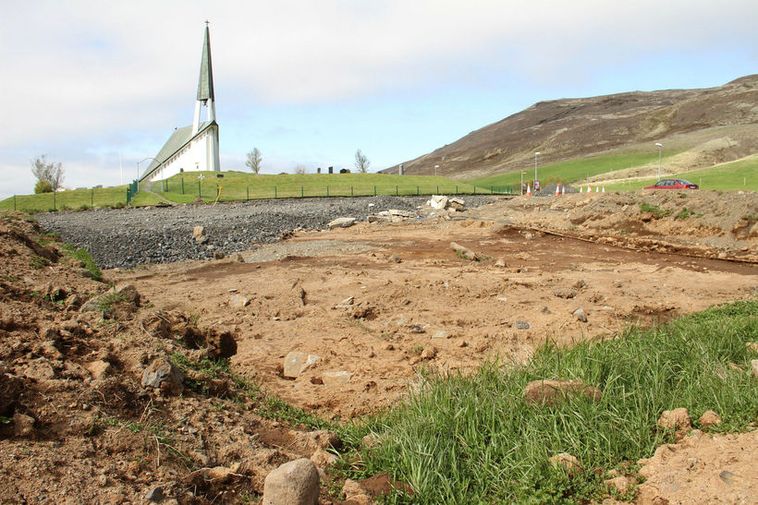
The archaeological site. Photo/Ragnheiður Traustadóttir

A team of Icelandic archaeologists has discovered occupation layers, dating back to the settlement of Iceland in the ninth century until the beginning of the 14th century, on Mosfell hill in Mosfellsdalur valley, just east of Reykjavík. The discovery is believed to be able to shed light on the history of the Middle Ages in the area.

Work on a new parking lot by Mosfellskirkja church was halted by the Cultural Heritage Agency of Iceland in April, and subsequent archaeological research revealed the layers. The agency decides this week whether excavations are to be continued. Only part of the site was damaged when work on the parking lot was in progress, according to archaeologist Ragnheiður Traustadóttir. The site seems to have been affected more in 1960, when a minister’s residence was built on the lot. Two areas are under investigation, one north of road leading up to the church, and the other east of the current parking lot.

Read the rest of this article...

Are these markings the handprint of a Pictish man?


Archaeologists believe they have discovered the hand markings of a Pictish man on an anvil found in Orkney. The find was made during an excavation on the island of Rousay, where the “unparalleled remains” of a smith’s workshop from the Pictish-era have been discovered.

A large stone anvil has been removed from the site with archaeologists claiming that carbon markings found on the metal working tool are imprints from a smith’s hands and knees. 

Dr Stephen Dockrill of the University of Bradford said analysis had confirmed that a copper smith worked in the semi-subterranean building now being excavated, with the site dating from 6th to 9th Century AD.

Read the rest of this article...
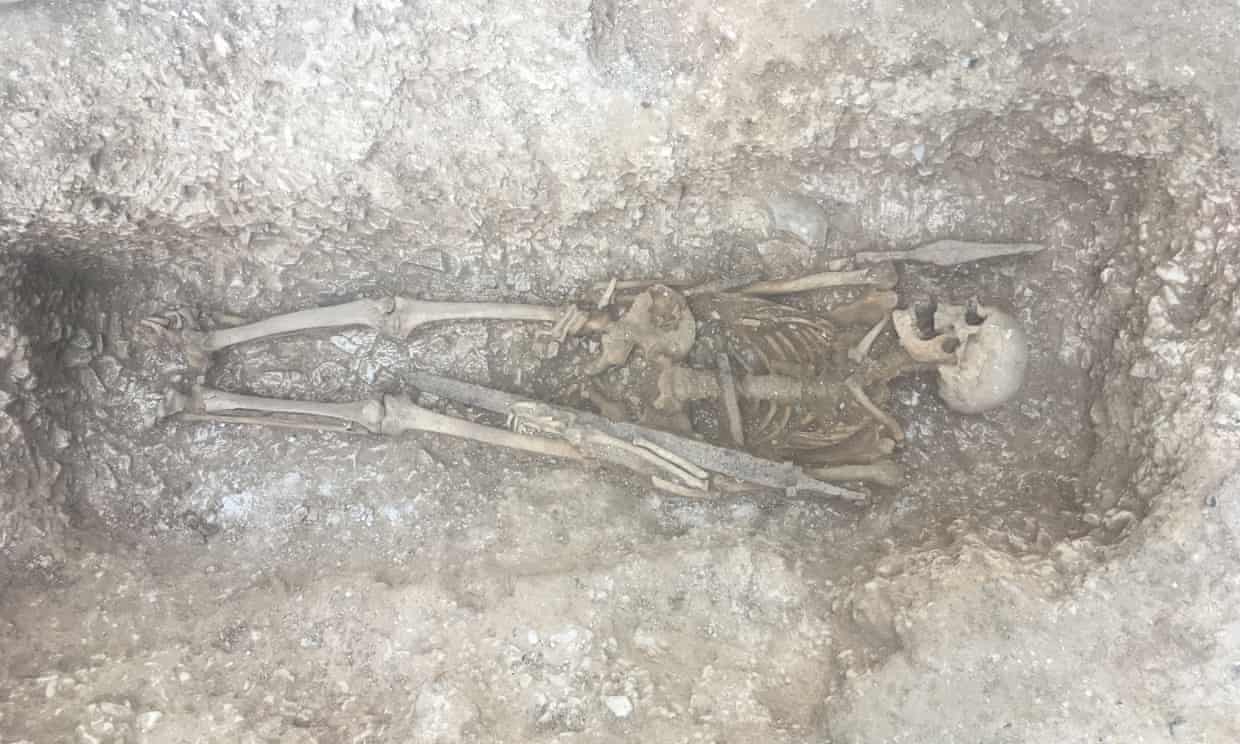
Soldiers find skeleton of Saxon warrior on Salisbury Plain


This 6th century Saxon warrior with spear and sword, was found underneath a military trackway, frequently crossed by tanks and huge military vehicles. 

Afghanistan war veterans helping out with archaeological dig on military grounds found scores of Saxon burials complete with weapons and jewellery

On the last day of an excavation by soldiers within the military training lands on Salisbury Plain, they found a comrade in arms: the grave of a 6th century Saxon warrior, buried with his spear by his side and his sword in his arms.

His bones and possessions, which included a handsome belt buckle, a knife and tweezers, were remarkably well preserved despite his grave lying under a military trackway on which tanks and massive military vehicles have been trundling across the plain. Pattern welded swords, high status objects, are rarely found intact: his was lifted in one piece, complete with traces of its wood and leather scabbard.

Read the rest of this article...

Archaeologists were hoping to find the first hermitage built in Cacela Velha, in Algarve, after the Christian conquest, but the remains that were unearthed in the area belonged instead to a medieval Christian necropolis and to an earlier Islamic settlement.

Cristina Garcia, from the Regional Direction of Culture (DRC) of Algarve, explains that the work is a continuation of the excavations undertaken in 1998 and 2001, in which the remains of what was thought to be the hermitage were detected, but it soon became apparent that the existing walls were, in fact, part of an Islamic bath abandoned by the Arabs before the Christian conquest and that they were later covered by a medieval Christian necropolis.

"Because the walls appeared to lie above the Christian necropolis, it was thought that they belonged to the hermitage, but only more burials of the medieval Christian cemetery were found, which had been used until the 15th or 16th century, and now we need to determine what the precise boundaries of this cemetery are", says Cristina Garcia.

Read the rest of this article...

Roadworks reveal remains of Iron Age village in York

An enclosure measuring 16 metres across is believed to date from the Iron Age 
[Credit: City of York Council]

The earliest find – a large ring ditch which could have been an enclosure or roundhouse – appears to date from the Iron Age, around 2,500 years ago. At around 16 metres in diameter, it is one of the biggest to be unearthed in York.

Pits and what looks to be a hearth have been found alongside, during roadworks at the roundabout of the junction with the road to Wetherby, on York’s outer ring road

A nearby ditch has produced a series of related finds, including decorated pottery fragments, a piece of quern-stone and industrial waste material in the form of molten slag.

Read the rest of this article...

Treasure found across Northern Ireland


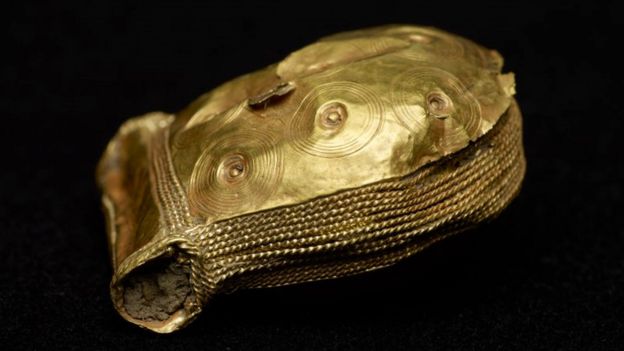
More than 40 objects found across Northern Ireland between 2009 and 2016 have been officially categorised as "treasure" by a coroner.
The items include a variety of precious rings, jewellery and Viking coins.
They were found by members of the public through metal-detecting, as well as by archaeologists on excavation.
After examination both by the coroner and the British Museum, some of the treasured items are now being held at the Ulster Museum in Belfast.
In Northern Ireland, any search for archaeological material that involves disturbing the ground requires a licence in advance from the Department for Communities' Historic Environment Division (HED)

Read the rest of this article...

Thursday, 19 July 2018

These burial treasures open a window into early Anglo-Saxon East Anglia

The Winfarthing Anglo-Saxon burial treasures. Courtesy Norwich Museums

Dr Tim Pestell, Senior Curator of Archaeology at Norwich Castle Museum and Art Gallery, on the recently acquired seventh century Winfarthing burial treasures and what they tell us about Anglo-Saxon East Anglia

Everyone goes “wow” over the pendant, but it is actually one component of a fascinating burial assemblage from the grave of a wealthy female dating to the seventh century. As much as the wonderful pendant stands out, the real story is as much about what we didn’t know about the Anglo-Saxon period at that date in East Anglia.

The find is also an example of really good metal detecting practice. A history student from UEA had been doing a lot of metal detecting on this particular farm in the parish of Winfarthing and in December 2015 he heard a fantastic signal. He dug down and realised that the bronze bowl he had found was beneath the plough soil.

Read the rest of this article...

Ancient marble head of god Dionysus discovered under Rome

The head of Dionysus was found near the Roman Forum. Photos:  Archeological Park of the Colosseum. Archeologists in Rome have uncovered a la...