Tuesday, 23 October 2018

AU CŒUR DE MÂCON, UNE NÉCROPOLE GALLO-ROMAINE


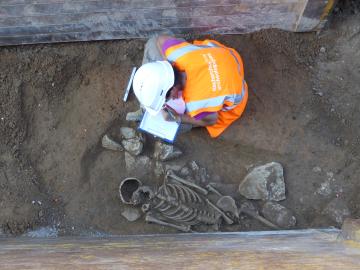
Cette fouille a permis de mettre au jour les vestiges de la nécropole dite « des Cordiers », datée de la période antique (Ier-VIe siècles). Ils documentent différentes pratiques funéraires gallo-romaines : les archéologues ont en effet découvert des aires de bûchers funéraires, des urnes cinéraires, des sépultures inhumées en coffrage de bois ainsi qu’un imposant sarcophage en pierre.

UNE NÉCROPOLE DES IER ET VIE SIÈCLES 
La ville gallo-romaine de Mâcon appelée Matisco est bien attestée par des cartes et des textes antiques. Cette agglomération se développe à la fin du Ier siècle avant notre ère, dès la conquête de la Gaule, pour se mettre définitivement en place au milieu du Ier siècle. À Mâcon comme ailleurs, selon les lois et traditions antiques, tandis que l’urbanisation de la ville se fixe intramuros, les nécropoles s’installent à l’extérieur, le long des axes de communications.

La fouille réalisée par l’Inrap va permettre aux scientifiques de documenter la nécropole « des Cordiers », implantée aux abords de la voie menant à Lyon. Les opérations archéologiques réalisées entre 1979 et 1982 ont révélé les premiers vestiges de cette nécropole. Parmi eux, des crémations des Ier et IIe siècle, des inhumations couvrant la période gallo-romaine ainsi que le sarcophage en grès d’un guerrier franc du VIe siècle.

Read the rest of this article...

Pompeii: Vesuvius eruption may have been later than thought

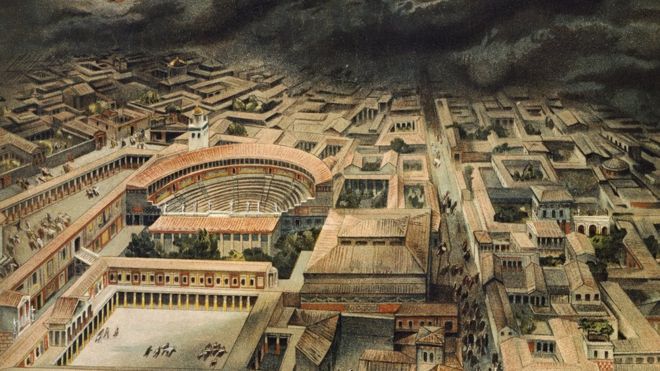
Pompeii was famously destroyed on 24 August in 79 AD - or was it?
GETTY IMAGES

Archaeologists in Italy have uncovered an inscription they say may show that the history books have been wrong for centuries.

Historians have long believed that Mount Vesuvius erupted on 24 August 79 AD, destroying the nearby Roman city of Pompeii.

But now, an inscription has been uncovered dated to mid-October - almost two months later.

Italy's culture minister labelled it "an extraordinary discovery."

"The new excavations demonstrate the exceptional skill of our country," Alberto Bonisoli said.

Read the rest of this article...

Mount Vesuvius murdered its victims in more brutal ways than we thought

Our visions of Pompeii's destruction just got a little more gruesome.
Giorgio Sommer/Public Domain

For nearly two millennia, the eruption of Mount Vesuvius has served as a stark reminder that nature is capable of some serious violence. The helpless residents of Pompeii and Herculaneum were inundated by volcanic horror, bludgeoned by hot ash avalanches that asphyxiated them while preserving their bodies for centuries afterward, within an unforgettable necropolis. At least, that’s what we always assumed. It turns out, many people probably died in ways that were more grisly than we imagined.

In findings published in PLOS One late last month, researchers from Naples, Italy found that a segment of Vesuvius victims were likely killed by fast-moving laving surges that streamed down toward the towns below, creating temperatures high enough to vaporize bodily fluids and create explosions in the skull. It’s about as horrific a way to go as you might imagine, and upends the notion that the toxic gases and thick chunks of ash were responsible for choking inhabitants to death during the AD 79 eruption.

Read the rest of this article...

Archaeologists uncover rare Celtic remains

A bronze clothes pin and ceramic object typically found in the 1st century BC.
(Kanton Luzern)

Archaeologists from canton Lucerne have uncovered rare Celtic remains on a construction site in the city of Egolzwil about 35 kilometres from the city of Lucerne. The discovery of a bronze piece of jewellery is considered a particularly exceptional finding.

The fact that Celts once lived in canton Lucerne has been known since sacrificial remains were found on the site of a former lake in the area some time ago. However, this new discovery, reported on Tuesday, is the first traces of settlements that have been found to date, which archaeologists hope can shed light on the history of the Celts in the area.

The excavation uncovered ceramic fragments, remains of burnt houses, and animal bones. A bronze brooch or clothes pin, believed to be a piece of jewellery used to tie clothes such as cloaks and coats, was also uncovered.

Based on the findings, archaeologists believe the settlement dates back to the first century BC.

Read the rest of this article...

Do Canadian Carvings Depict Vikings? Removing Mammal Fat May Tell

Credit: Shutterstock

Carvings uncovered in the Canadian Arctic may be the earliest portraits of the Vikings created in the Americas. But archaeologists have been puzzling over whether the artwork really shows the infamous seafarers.

Now, scientists think a simple, flammable liquid called acetone could help solve this mystery by removing sea-mammal oil and fat from these artifacts and other artifacts found near them. Until now, those contaminants have prevented scientists from getting an accurate radiocarbon date, according to a paper published in the August issue of the Journal of Archaeological Science.

Oily problem
The Vikings, along with other peoples who lived in arctic or subarctic environments, used oils and fat from sea mammals for a variety of purposes, including preparing food and cooking. The substances interfere with radiocarbon dating, because rather than getting the date of the artifact, you may get the date for the oil and fat covering the object, study authors Michele Hayeur Smith, Kevin Smith and Gørill Nilsen wrote in the new paper.

Read the rest of this article...

Extraordinary Viking Age Thor’s Hammer Amulet Discovered in Iceland

Photo: Fornleifastofnun Íslands/The Institute of Archaeology, Iceland

A sandstone Thor’s hammer amulet has been found at the Viking-era farmstead Bergsstaðir in Þjórsárdalur valley. The site was last occupied 900 years ago and the amulet is believed to be around the same age. Only one Thor’s hammer has ever been found in Iceland before.

“These are all objects from the Viking age,” said Ragnheiður Gylfadóttir, an archaeologist with Iceland’s Institute of Archaeology, speaking with ruv.is.

When the team arrived at the site, she said, they quickly found rocks that looked like they could have been foundations for longhouse walls. In addition, they found remnants of human habitation, such as an ash pile and burned bones.

“We found a so-called ‘heinarbrýni.’ It’s a type of whetstone that was usually kept on the belt, used to sharpen needles, for example,” continued Gylfadóttir. “And we found a fragment from a soapstone pot.”

Read the rest of this article...

Byzantine Tower In Istanbul Collapses

Credit: Hurriyet Daily News

A Byzantine tower in the centre of modern Istanbul [Constantinople] has collapsed while deep cracks have also appeared in the adjacent sections of the ancient walls.
Indeed, many sections of the Byzantine walls have likewise been left to crumble or have changed form due to modern 'restoration' projects.

The old city is surrounded by a total of 22 kilometre long walls in three main sections, namely, the 'Land Walls' on the west, the 'Golden Horn Walls' on the north and the 'Marmara Walls' in the south and east.

Read the rest of this article...

Ancient marble head of god Dionysus discovered under Rome

The head of Dionysus was found near the Roman Forum. Photos:  Archeological Park of the Colosseum. Archeologists in Rome have uncovered a la...