Tuesday, 20 November 2018

Viking city: excavation reveals urban pioneers not violent raiders

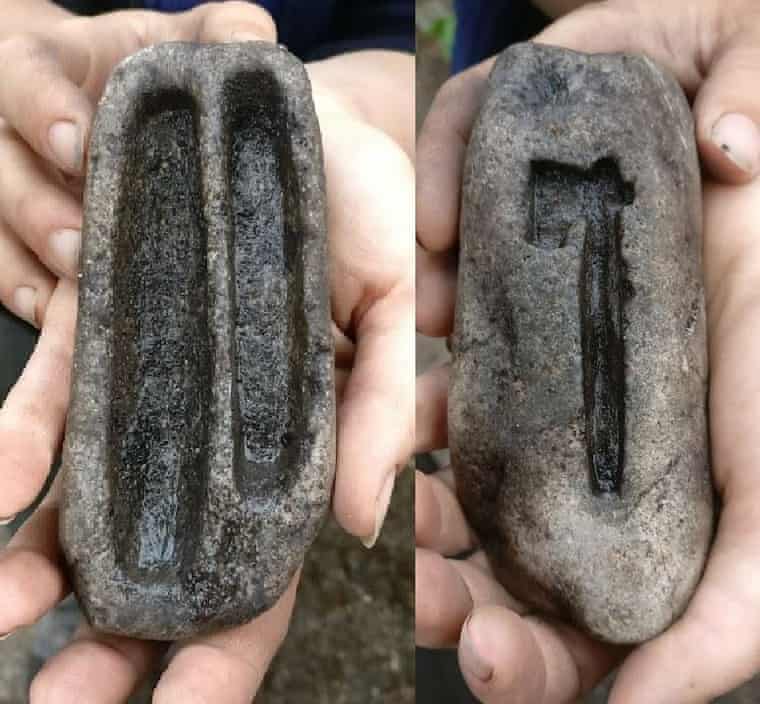
Mould carved from soapstone for making ingots and and an axe amulet, both discovered at Ribe. Photograph: Museum of Southwestern Jutland

Excavations in Ribe, Denmark show that Viking culture was based on sophisticated production and trade. Is their brutal reputation unfair?

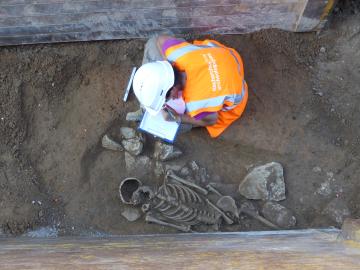
In an extraordinary moment captured on film this summer, the tuning pegs and neck of a lyre, a harplike stringed instrument, were carefully prised out of the soil of Ribe, a picturesque town on Denmark’s south-west coast. Dated to around AD720, the find was the earliest evidence not just of Viking music, but of a culture that supported instrument-makers and musicians.

The same excavation also found the remains of wooden homes; moulds for fashioning ornaments from gold, silver and brass; intricate combs made from reindeer antlers (the Viking equivalent of ivory); and amber jewellery dating to the early 700s.

Even more extraordinary, however, was the discovery that these artefacts were not for home consumption by farmers, let alone itinerant raiders. Instead, the Vikings who made them lived in a settled, urban community of craftsmen, seafarers, tradesmen and, it seems, musicians.

Read the rest of this article...

Tuesday, 13 November 2018

How Industrial-Scale Tar Production Powered the Viking Age

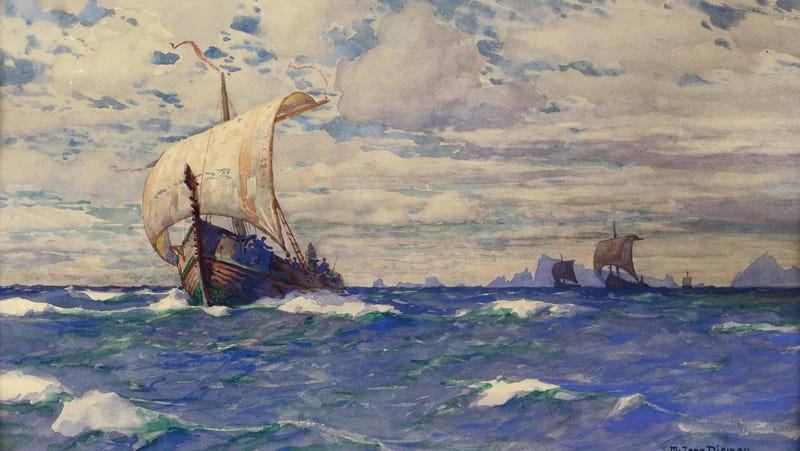
“Viking Ships Before a Rocky Coast,” by Michael Zeno Diemer (1911)
Image: Wikimedia

Vikings acquired the capacity to produce tar at an industrial scale as early as the 8th century AD, according to new research. The protective black goo was applied to the planks and sails of ships, which the Vikings used for trade and launching raids. Without the ability to produce copious amounts of tar, this new study suggests, the Viking Age may have never happened.

Tar sounds like a relatively modern invention, but it’s actually been around for quite some time. By the 16th century, Europeans had developed a technique whereby piles of wood, placed in funnel-shaped pits, were burned slowly under an oxygen-constricting layer of an earth-clay mixture and charcoal. Dripping tar from the burning wood fell into an outlet pipe, from which the precious material was collected.

Read the rest of this article...
The secret of Viking success? A good coat of tar…

Industrial pits led to waterproofed ships for epic pillaging raids


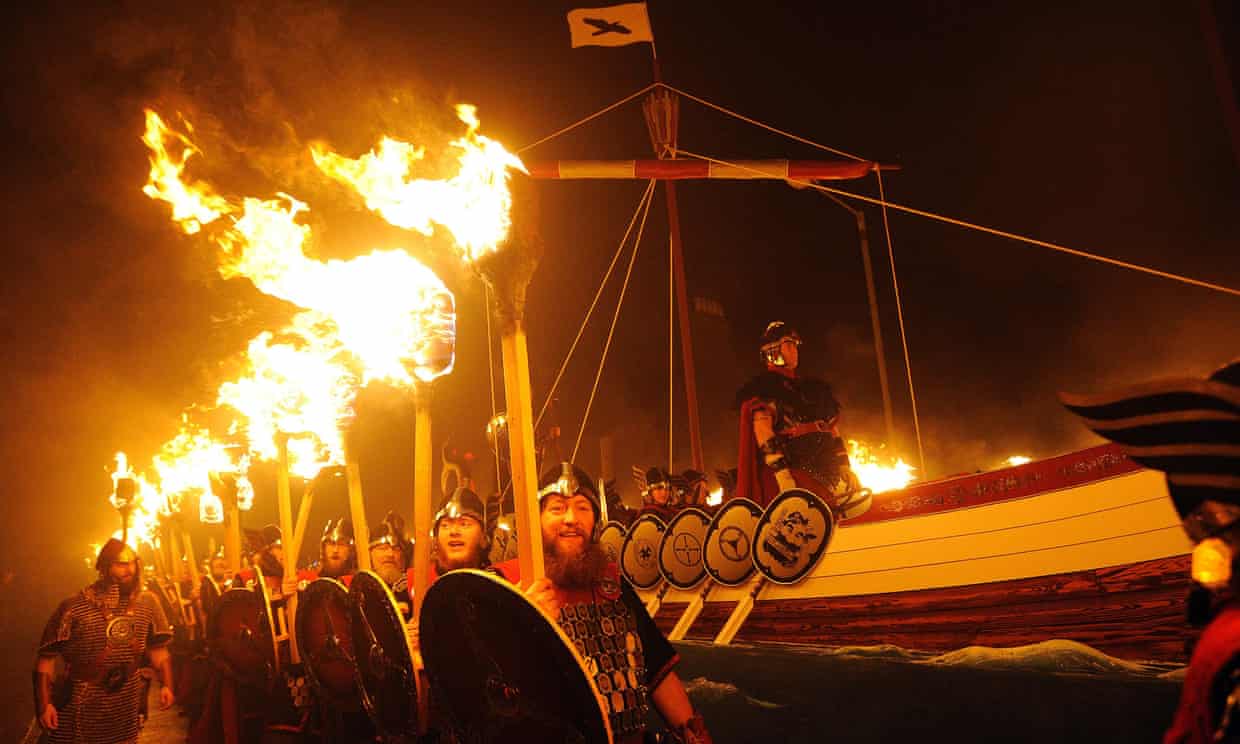
A replica Viking longboat in the Up Helly Aa festival in Lerwick, Shetland Islands. The Norse warrior race dominated European seas in the 8th century. 
Photograph: Andy Buchanan/AFP/Getty

Vikings conquered Europe thanks to an unexpected technological innovation. They learned how to make tar on an industrial scale and used it to waterproof their longships so that they could undertake large-scale, lengthy pillaging trips around Europe – and across the Atlantic, say archaeologists. Norse raiders were the original Boys from the Blackstuff, it transpires.

The discovery is the work of Andreas Hennius, of Uppsala University. In Antiquity, he reports finding critical evidence that shows output from tar pits in Scandinavia increased dramatically just as Vikings began raiding other parts of Europe. These pits could have made up to 300 litres in a single production cycle, enough to waterproof large numbers of ships. “Tar production … developed from a small-scale activity … into large-scale production that relocated to forested outlands during the Viking period,” says Hennius. “This change … resulted from the increasing demand for tar driven by an evolving maritime culture.”

Read the rest of this article...

Tuesday, 6 November 2018

Norse World goes live!


And the Norse World resource goes live! Today, on 7 November the research infrastructure Norse World is being released with free access for researchers and the members of the public.
Norse World is an interactive spatial-temporal resource for research on spatiality and worldviews in medieval literature from Sweden and Denmark. Go to the map to see for yourself! Or find out more about the project and the Norse World infrastructure.

Read the rest of this article...

Tuesday, 23 October 2018

AU CŒUR DE MÂCON, UNE NÉCROPOLE GALLO-ROMAINE


Cette fouille a permis de mettre au jour les vestiges de la nécropole dite « des Cordiers », datée de la période antique (Ier-VIe siècles). Ils documentent différentes pratiques funéraires gallo-romaines : les archéologues ont en effet découvert des aires de bûchers funéraires, des urnes cinéraires, des sépultures inhumées en coffrage de bois ainsi qu’un imposant sarcophage en pierre.

UNE NÉCROPOLE DES IER ET VIE SIÈCLES 
La ville gallo-romaine de Mâcon appelée Matisco est bien attestée par des cartes et des textes antiques. Cette agglomération se développe à la fin du Ier siècle avant notre ère, dès la conquête de la Gaule, pour se mettre définitivement en place au milieu du Ier siècle. À Mâcon comme ailleurs, selon les lois et traditions antiques, tandis que l’urbanisation de la ville se fixe intramuros, les nécropoles s’installent à l’extérieur, le long des axes de communications.

La fouille réalisée par l’Inrap va permettre aux scientifiques de documenter la nécropole « des Cordiers », implantée aux abords de la voie menant à Lyon. Les opérations archéologiques réalisées entre 1979 et 1982 ont révélé les premiers vestiges de cette nécropole. Parmi eux, des crémations des Ier et IIe siècle, des inhumations couvrant la période gallo-romaine ainsi que le sarcophage en grès d’un guerrier franc du VIe siècle.

Read the rest of this article...

Pompeii: Vesuvius eruption may have been later than thought

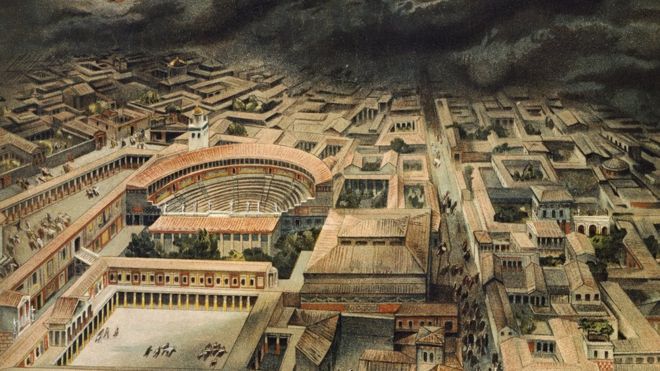
Pompeii was famously destroyed on 24 August in 79 AD - or was it?
GETTY IMAGES

Archaeologists in Italy have uncovered an inscription they say may show that the history books have been wrong for centuries.

Historians have long believed that Mount Vesuvius erupted on 24 August 79 AD, destroying the nearby Roman city of Pompeii.

But now, an inscription has been uncovered dated to mid-October - almost two months later.

Italy's culture minister labelled it "an extraordinary discovery."

"The new excavations demonstrate the exceptional skill of our country," Alberto Bonisoli said.

Read the rest of this article...

Mount Vesuvius murdered its victims in more brutal ways than we thought

Our visions of Pompeii's destruction just got a little more gruesome.
Giorgio Sommer/Public Domain

For nearly two millennia, the eruption of Mount Vesuvius has served as a stark reminder that nature is capable of some serious violence. The helpless residents of Pompeii and Herculaneum were inundated by volcanic horror, bludgeoned by hot ash avalanches that asphyxiated them while preserving their bodies for centuries afterward, within an unforgettable necropolis. At least, that’s what we always assumed. It turns out, many people probably died in ways that were more grisly than we imagined.

In findings published in PLOS One late last month, researchers from Naples, Italy found that a segment of Vesuvius victims were likely killed by fast-moving laving surges that streamed down toward the towns below, creating temperatures high enough to vaporize bodily fluids and create explosions in the skull. It’s about as horrific a way to go as you might imagine, and upends the notion that the toxic gases and thick chunks of ash were responsible for choking inhabitants to death during the AD 79 eruption.

Read the rest of this article...

Ancient marble head of god Dionysus discovered under Rome

The head of Dionysus was found near the Roman Forum. Photos:  Archeological Park of the Colosseum. Archeologists in Rome have uncovered a la...